William Blake: A Slow Show Illustrations to Young’s Night Thoughts
William Blake
Late in 2000 I visited the Tate in London to see a William Blake exhibition. The energy and emotional force of his work stayed with me long after I left. One image in particular lodged itself in my mind – his depiction of Issac Newton, seated and absorbed, a triangle in his hand, a man in his flow. Around him, the world feels alive, detailed foliage clings to rock, the sky looks endless and the patterned muscles of his body seemed to echo the rhythms of thought itself.
Many years later I came to own this collection, Young’s Night Thoughts illustrated by Blake. His heartfelt vision continued to resonate deeply for me – his honest imagination, his belief in a spiritual and emotional life and his refusal to dilute his voice.
Blake was hardly celebrated in his own life-time, he marched to a different drum and remained faithful to his own inner thoughts even when they set him apart. Today, it feels natural to recognise in him something many neurodivergent people know well – the experience of thinking differently.
This exhibition reflects my own relationship with creativity, my lifelong belief in our inner necessity to create and in the need to trust our inner world’s individual deep thinking.
Here, At 6s & 7s, Blake is offered as a slow show – with time to linger, to think, to handle these prints. Not as precious objects behind glass, but as living works that continue to comfort and disturb us in equal measure.
William Blake ( 1757 – 1827 ) was an English artist, a poet and a print maker. He believed poetry and image belonged together and invented his own method of relief etching so he could control both word and picture. Blake believed imagination was sacred. For him, art wasn’t just decorative or an illustration, for him it was a way of communicating and seeing truth.
As Blake didn’t aim for mass popularity, he was little known during his lifetime and was often dismissed as eccentric, even mad. He reached – and still reaches- the individual not the crowd. He rejected new and faster methods in printing in favour of artistic independence. His books were made by hand in small numbers and so his work feels like a private conversation rather than a public announcement. But as his choice came with a price being both time consuming and expensive, poverty was his constant companion. Thankfully he had his supporters, fellow artists and poets those who supported him with commissions. The Ancients, a group of young artists who were inspired by his passion and fervour and were there for him in his final years. But primarily his wife Catherine Boucher who believed in him, in his visions and who helped his in every aspect of his creative life.
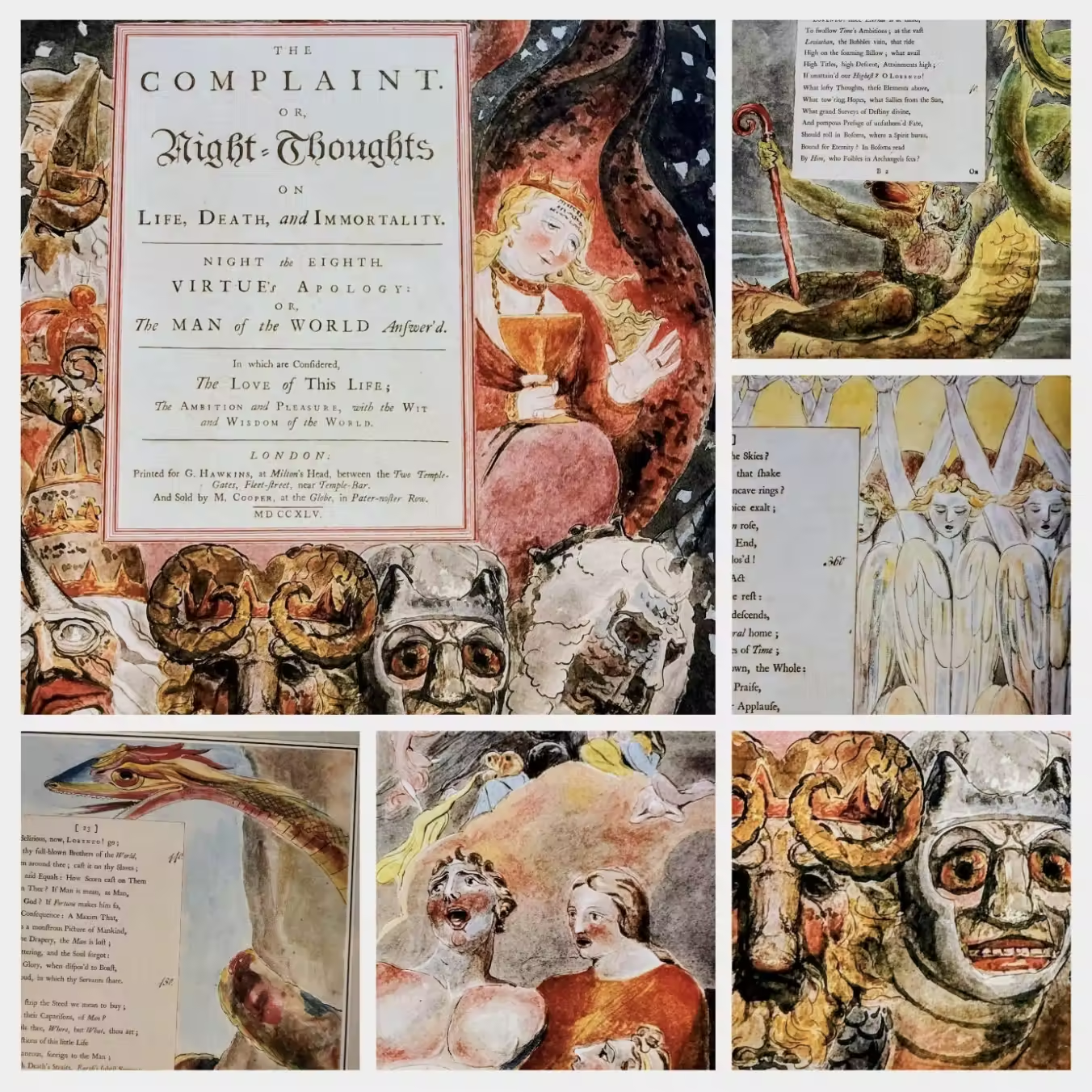
In 1797 Blake was commissioned to illustrate every page of Edward Young’s lengthy poem Night Thoughts – a total of 537 watercolours. He was paid £21 by bookseller Richard Edwards, from these 150 were chosen and engraved by Blake and were to be published in four volumes. The first volume which contained 43 illustrations was a commercial failure and sadly no further volumes were published, this you can be sure weighed heavily on Blake.
The illustrations shown here are from a 1927 publication of Edward Young’s poem Night Thoughts published by Fogg Museum of Art, Harvard University MA. Based on the original watercolour collection of 537 owned by William Augustus White an American businessman and collector. We have five colour plates and twenty-five monochrome plates produced in a blue portfolio, loose and unbound. This was a limited edition of 500 with an introduction by Geoffrey Keynes. In this format they were certainly intended for close study. Blake’s illustrations were themselves acts of deep attention and meditation, on loss and solitude, exclusion and questioning. I hope in this exhibition and nearly two centuries later they continue to speak to those willing to pause and stay with them.
Geoffrey Keynes ( 1887 – 1982 ) was a scholar, a bibliophile and British surgeon, he was among other things a leading authority on the work of William Blake.
Without a doubt his experiences in World War1 and again World War 11 as both a medic and humanitarian coloured every aspect of his private and professional life. Kindness, empathy and sensitivity appear to have been his currency, his contribution to the treatment of breast cancer, blood transfusions and thyroid problems we benefit from to this day. He married Margaret Darwin, granddaughter to Charles Darwin and I am inclined to think he too was in the company of those who refused to stay in the one lane.
Keynes had a particular sensitivity to Blake’s works including Night Thoughts, he was careful and respectful in opening up the space to restoring Blake’s reputation in the twentieth century. His work helped reframe Blake as a visionary artist whose images require slow and thoughtful looking. In his response to Night Thoughts Blake’s images capture the depth and intensity of mortality, grief and loss. Keynes understood this: attention before explanation and encounter before interpretation.
So, you are invited to meet these images without rushing to interpretation, they are not presented as historical documents alone. They are meant to be looked at slowly, handled carefully and encountered personally.
Edward Young ( 1683 – 1765 ) was an English clergyman and poet. He wrote Night’s Thoughts after a series of personal losses, the death of his wife, his step daughter and close friends. It belongs to the hours of wakefulness, a familiar time for many of us when certainty thins and questions deepen but remain unanswered. The poem gives space to uncertainty and anxiety and gives room to darkness and fear.
I imagine when Blake illustrated Night’s Thoughts the poem resonated with him and though it was decades later he recognised a kindred spirit in Young. I imagine Keynes also reflected on grief, mortality, faith, the passing of time and the meaning of life.
My final though is all men, their art, poetry and life’s work did not resolve doubt so much as stay with it and that there is an art in allowing darkness, difference, fear and longing coexist with hope.
~ Gerry Carew